


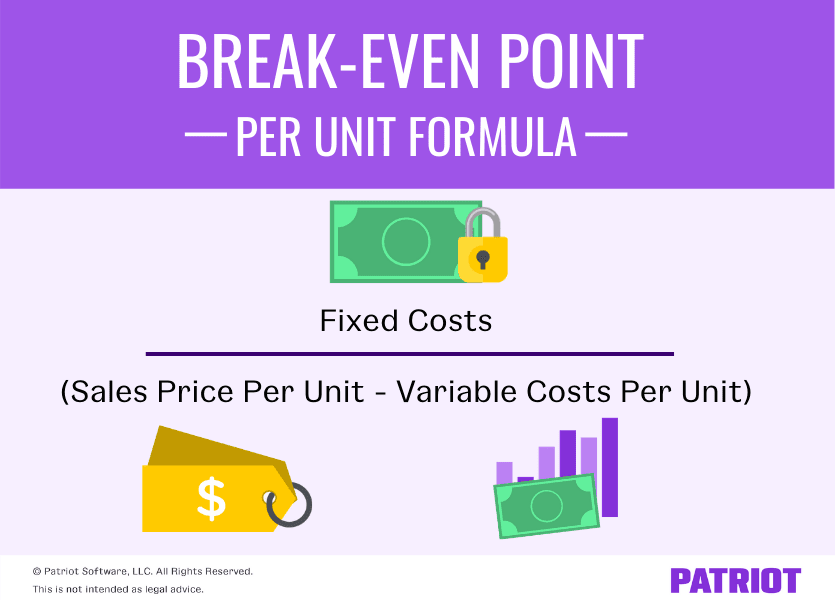
Use this calculator to determine the number of units required to breakeven plus the potential profit you could make on your anticipated sales volume. In contrast to fixed costs, variable costs increase (or decrease) based on the number of units sold. If customer demand and sales are higher for the company in a certain period, its variable costs will also move in the same direction and increase (and vice versa). Variable costs are the costs that are directly related to the level of production or number of units sold in the market. Variable costs are calculated on a per-unit basis, so if you produce or sell more units, the variable cost will increase. Some common examples of variable costs are commissions on sales, delivery charges, and temporary labor wages.
How to use break even calculations
A breakeven point tells you what price level, yield, profit, or other metric must be achieved not to lose any money—or to make back an initial investment on a trade or project. Thus, if a project costs $1 million to undertake, it would need to generate $1 million in net profits before it breaks even. The breakeven point is important because it identifies the minimum sales volume needed to cover all costs, ensuring no losses are incurred.

Increase product prices
Break-even analysis works well for short-term planning, like setting immediate sales goals or dedication to prices. Let’s say you run a small bakery and plan to expand the bakery by opening a second location next year. Your break-even analysis alone won’t factor in the increased rent, higher utility bills, or additional staff wages. In this situation, it’s best to use forecasting tools like financial projections or budgeting software to account for future expenses and revenue growth. The biggest use for break-even analysis is to determine whether or not your company is breaking even. Finding the break-even point of your business allows you to determine how much more revenue you need to generate in order to reach a profit.
- Each tool is carefully developed and rigorously tested, and our content is well-sourced, but despite our best effort it is possible they contain errors.
- In addition, changes to the relevant range may change, meaning fixed costs can even change.
- While the breakeven point is a valuable tool for decision-making, it has several limitations.
- This is why big companies like apple release their new iPhone in a controlled manner.
- He currently researches and teaches economic sociology and the social studies of finance at the Hebrew University in Jerusalem.
Break Even Point Calculation Example (BEP)
Get stock recommendations, portfolio guidance, and more from The Motley Fool’s premium services. Break-even analysis is an important way to help calculate the risks involved in your endeavor and determine whether they’re worthwhile before you invest in the process. If you find yourself 9 simple steps to prepare your bas using xero asking these questions, it’s time to perform break-even analysis. Read on to learn all about how break-even analysis can serve your small business. The articles and research support materials available on this site are educational and are not intended to be investment or tax advice.
How to Conduct Break-Even Analysis
For instance, if shipping costs rise due to global supply chain problems, your variable costs might go up and can throw off your original calculation. Similarly, If a competitor starts offering big discounts, your projected sales might drop and may cause you to miss your break-even point. As you can see, the Barbara’s factory will have to sell at least 2,500 units in order to cover it’s fixed and variable costs. Anything it sells after the 2,500 mark will go straight to the CM since the fixed costs are already covered.
Part 2: Your Current Nest Egg
Break-Even Analysis is important because it helps businesses understand how many units they need to sell to cover their costs and start making a profit. Break-Even Analysis is a financial calculation that helps businesses determine the number of units they need to sell to cover their costs. It helps businesses understand the point at which they will start making a profit. The break even analysis helps you calculate out your break-even point. If your business sells a product, enter the cost of the components that go into making the product.
Fixed costs are costs that do not change based on your production or sales volume (e.g., rent, insurance, and salaries). Variable costs are costs that fluctuate depending on how much you produce (e.g., raw materials, labor per unit). Break-even analysis looks at internal costs and revenues, but doesn’t factor in external influences that can impact your business. — e.g., changes in market demand, economic conditions, inflation, supply chain disruptions, etc.
Break-even analysis looks at fixed costs relative to the profit earned by each additional unit produced and sold. Let’s say that we have a company that sells products priced at $20.00 per unit, so revenue will be equal to the number of units sold multiplied by the $20.00 price tag. The Break-Even Point (BEP) is the inflection point at which the revenue output of a company is equal to its total costs and starts to generate a profit. Ready to find out how many units you need to sell to cover your costs?